
SUP Sails & WindSUP Rigs
Filters
8 products


SUP Sails – Windsurf Sails and Inflatable Sails for WindSUP
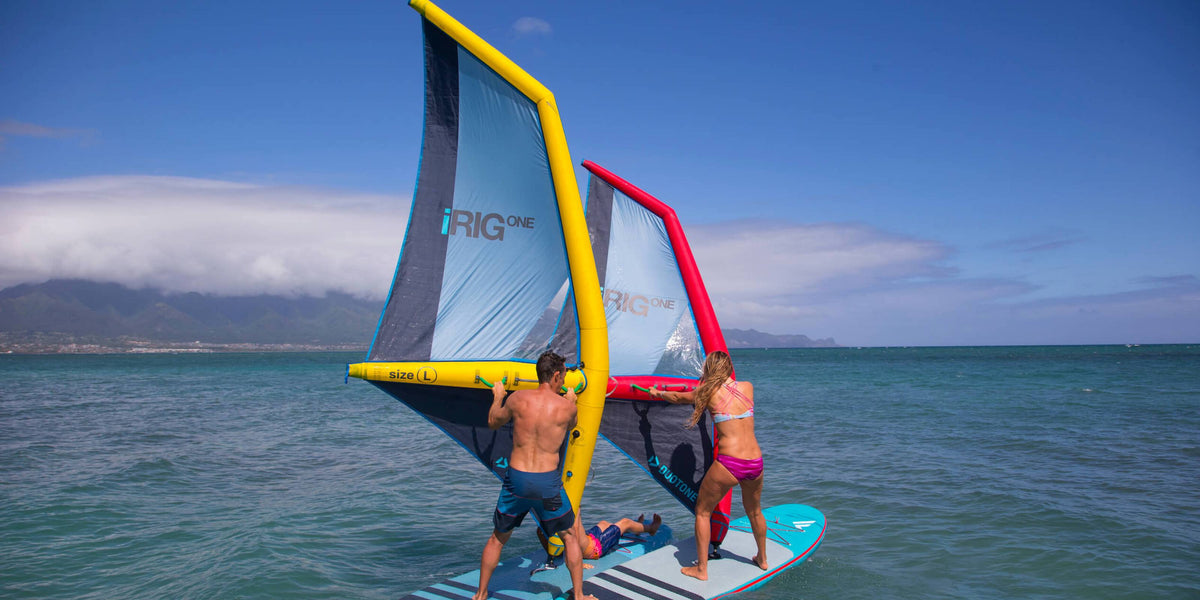
A SUP sail is a windsurf sail that you attach to your paddle board so the wind drives you instead of your paddle. This is known as windSUP. You can learn the basics of windsurfing in light wind, and when the wind drops, you simply take the sail off and carry on paddling. That gives you one board for two sports.
Our range includes rigid and inflatable SUP sails, adapters for fitting a sail to a standard SUP, twin fins that stop sideways drift, and handheld wind meters.
Which SUP Sail Should I Choose?
| Who and where | What to choose |
|---|---|
| Kids (lighter, first steps) | smaller sail, around 2.5 m² + inflatable sail |
| Adult beginners (light wind) | sail around 3.5 to 4.5 m² + twin fin |
| SUP without a mast insert (standard inflatable SUP) | inflatable sail + adapter strap |
| WindSUP board with a mast insert (built-in sail fitting) | rigid or inflatable sail |
| Travel (little space in the car) | inflatable sail that packs into a bag |
Rigid Windsurf Sail or Inflatable Sail?
| Type | Features |
|---|---|
| Rigid sail (mast, boom, film) | more responsive + uses the wind more efficiently + needs a mast insert |
| Inflatable sail (almost no rigid parts) | very light + floats + packs into a small bag |
A rigid sail has a mast and boom and is made of monofilm and Dacron, so it holds its shape in the wind and responds precisely. An inflatable sail is held in shape by air instead of a mast, which makes it much lighter. Beginners find it easier to lift out of the water, and if you fall, there's no hard mast to hit you.
How Do I Attach a Sail to My SUP?
- WindSUP board with a mast insert: the board has a built-in threaded insert that you screw the mast base into.
- Standard SUP without an insert: fit an inflatable sail with an adapter, a strap with a base plate that you tighten around the widest part of the board. No drilling needed.
The adapter strap is designed for lightweight inflatable sails. For a rigid sail, you need a board with a mast insert. You'll find these in our SUP boards, and a replacement insert in our SUP spare parts.
Twin Fins to Stop Your SUP Drifting Sideways
Beginner windsurf boards have a centreboard that stops the wind pushing you sideways. Most SUPs don't, so the wind pushes them downwind and it's hard to get back to where you started. A twin fin under the middle of the board helps you hold your line, so you can sail back and forth in the same area. It straps under the board without glue, and you can use it with a sail or a wing. Check your board's width before you buy, as some fin mounts need a wider SUP.
Sail Size and Wind Strength
A bigger sail catches more wind, while a smaller one is easier to control. When learning, go for a smaller sail rather than one that's too big.
- around 2.5 m² – kids and lighter beginners,
- around 3.5 m² – teenagers and adult beginners,
- around 4.5 m² – adults in light wind or heavier riders.
The best conditions for learning are light to gentle winds, around Beaufort 2 to 3 (roughly 6 to 19 km/h).
Wind Meter – How Much Wind Is Enough?
A handheld wind meter (anemometer) shows how hard the wind is blowing on your beach before you head out. Forecasts are only a guide, as wind changes quickly between bays and along the shore. A wind meter helps you judge the conditions and decide whether the wind suits your skill level and sail size.
Staying Safe When Sailing a SUP
Never sail in offshore wind blowing from the shore towards open water, as it pushes you away and makes it hard to get back. Start where the wind blows along the shore, in a bay or on a lake. Kids and beginners should wear a buoyancy aid. If you fall, stay with your board, which floats and keeps you on the surface.
Who Is a SUP Sail For?
- anyone with a SUP who wants to try windsurfing,
- families who want to paddle and sail on one board,
- kids learning to sail,
- windsurfers who want lighter kit for holidays and smaller cars.
How to Care for Your SUP Sail
After sailing in the sea, rinse the sail with fresh water and dry it in the shade before packing it away, so mould doesn't form. Deflate an inflatable sail and fold it only when it's dry. Don't leave the sail in the sun for long, as UV rays weaken the material over time.
Related categories
SUP boards · Wings · SUP fins · SUP spare parts · SUP accessories