
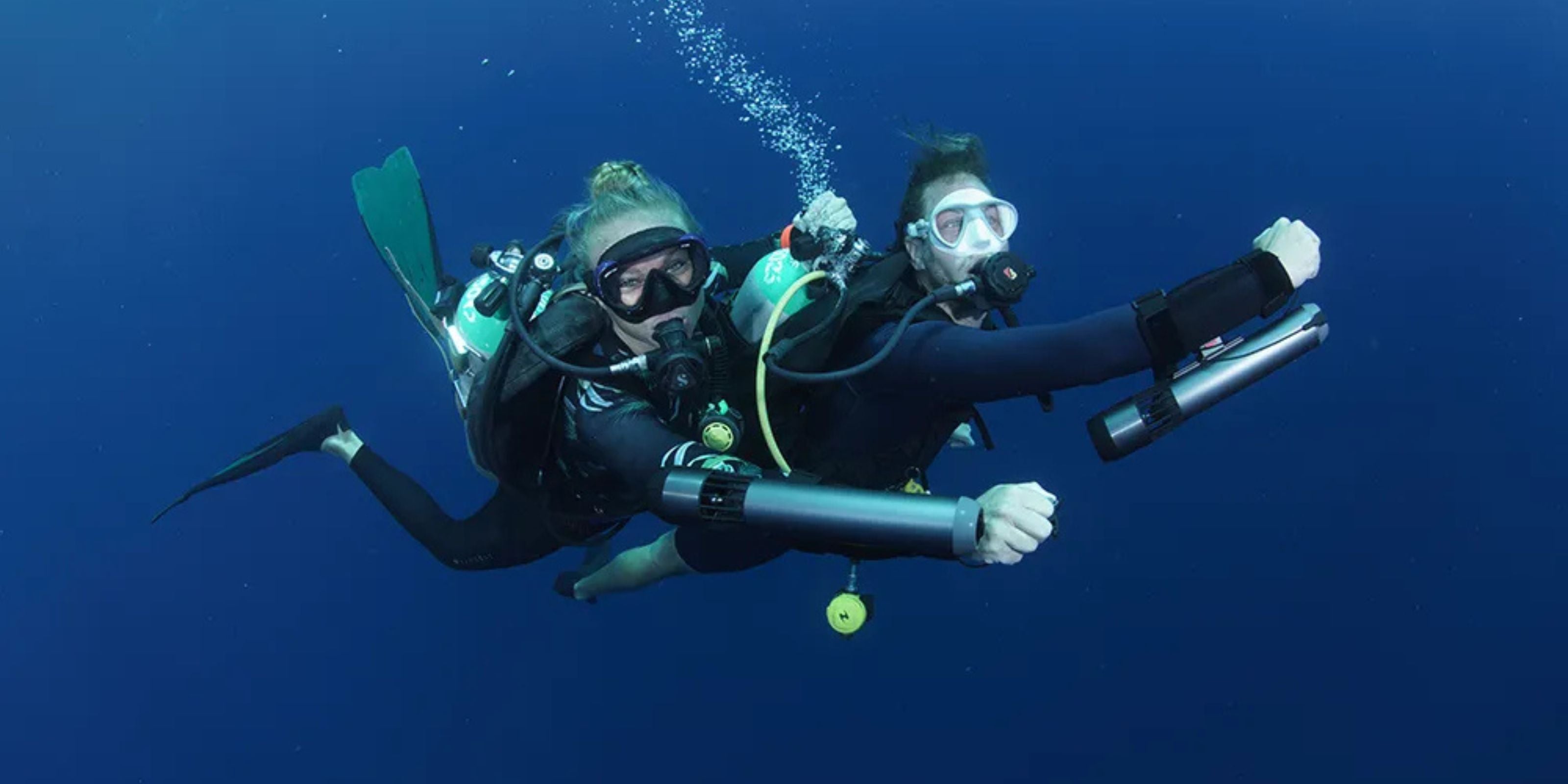
Sea Scooters
Filters
1 product


Sea scooters: explore more underwater with less effort
A sea scooter glides you through the water effortlessly: an electric motor spins a propeller that pulls you forward while you simply hold on and steer. Instead of kicking against currents and waves, you let the scooter do the work, so you stay underwater longer, tire less, and conserve air while diving.
Our range of sea scooters suits snorkeling, diving, and fun in the sea or pool alike – for recreational users, families, and more demanding divers.

How a sea scooter works?
A sea scooter (also called an underwater scooter, or DPV – diver propulsion vehicle) is driven by an electric motor that turns a propeller inside a waterproof housing. Operation is simple: press a trigger or finger ring to engage the thruster, then steer left, right, up, or down with your body.
Modern underwater scooters feature multiple speed gears, a propeller guard, and a battery you recharge via USB-C or a charger. No diving certification is needed – a few minutes of practice is enough.
Why use a sea scooter?
An electric underwater scooter is more than a toy for the water. It extends bottom time for divers and snorkelers, because your body rests while the motor does the work.
It adds fun for families at the beach or in the pool, lets creators capture steady underwater footage with a mounted action camera, and helps paddlers fight their way back against the current alongside a SUP or kayak. In short: more experience, less effort.
How to choose a sea scooter
Focus on four factors:
- Depth. Snorkeling needs only a few meters, but diving demands a real depth rating. Recreational models typically handle 30 to 60 m.
- Speed and thrust. A stronger motor handles currents more easily. Most recreational sea scooters reach 1 to 2 m/s (roughly 4–7 km/h), with motor power between 300 and 800 W.
- Runtime. A bigger battery means longer exploring. Expect 30 to 90 minutes depending on the gear you choose and the conditions.
- Portability and safety. Weight decides whether you actually bring it along – portable models weigh around 1.5 to 3 kg, and a battery under 100 Wh is allowed in airline carry-on luggage. For family use, choose a model with a finger guard.
Where to use a sea scooter
A sea scooter works in both salt and fresh water – snorkeling over reefs, scuba and free diving, cruising beside a SUP or kayak, pool play, and underwater photography. One device covers multiple activities, from relaxed fun to serious exploring.

Sea scooter price
The price of a sea scooter depends mainly on motor power, depth rating, battery capacity, and brand. As a rough guide:
- Entry-level models for the pool and play: around €100–300.
- Recreational models for snorkeling and light diving: around €300–900.
- High-performance models for diving and professional use: €1,000 and up; technical DPVs for deep diving can reach several thousand euros.
Don't judge by price alone – weigh the balance of depth, speed, runtime, and weight. A cheaper model you leave at home because it's too bulky is no saving at all. Check the current price of our sea scooters on the product in this collection.