Quick Summary
The optimal paddle board for your weight is one whose load capacity exceeds your body weight by at least 2x. If you weigh 90 kg (198 lbs), look for boards with a load capacity of at least 180 kg (397 lbs) — anything lower will be structurally weak and not stable enough for you.
When choosing a SUP, watch for two different numbers:
- Maximum load capacity — the upper limit of how many kilograms the board will physically hold above water
- Recommended paddler weight — the weight at which the board delivers the best experience (stability, glide, less effort)
The most common buyer mistake: manufacturers often sell boards rated for 130–140 kg (287–309 lbs) load capacity to people who weigh 70–90 kg (154–198 lbs). It seems like enough — but in practice, it isn't. The 2× weight rule exists because construction tolerances in lower price ranges don't hold the declared values.
Optimal Paddle Board Width by Weight
Width is the most important factor for stability. The table below shows the recommended widths for beginners and experienced paddlers based on weight:
| Paddler Weight | Width — Beginner | Width — Experienced |
|---|---|---|
| up to 60 kg (132 lbs) | 30'' (76 cm) | 28'' (71 cm) |
| 60–90 kg (132–198 lbs) | 32'' (81 cm) | 30'' (76 cm) |
| 90–110 kg (198–243 lbs) | 32''–34'' (81–86 cm) | 30''–32'' (76–81 cm) |
| 110+ kg (243+ lbs) | 34'' (86 cm) | 32'' (81 cm) |
Optimal thickness with quality construction depends on the board's length: 10 cm (4'') for boards up to 10', 12 cm (4.7'') for 10'–12', and 15 cm (6'') for boards longer than 12'. With cheaper single-layer boards, manufacturers often increase thickness by one category to compensate for lower rigidity — but this hurts the board's on-water performance.

The picture shows a paddle board that's too thick for its length.
Optimal length connects to the board's shape: all-around SUPs are shorter (10'–11', 304–335 cm) and therefore more manoeuvrable — perfect for exploration, play, and versatile riding. Touring SUPs are longer (11'–13', 335–390 cm) and less manoeuvrable, but track better and are preferred by paddlers who want to cover more kilometres.
SUP Quiz
Not sure which paddle board to choose? Take our quiz!
Right after you complete the quiz, we'll send you a personalised recommendation of the most suitable SUP boards for your weight, experience and paddling style.
Take the SUP Quiz →Why Your Body Weight Is the Most Important Factor When Choosing a Paddle Board
The same SUP behaves completely differently under a 60 kg (132 lbs) and a 100 kg (220 lbs) paddler. The reason is simple: if the board is too small for you, you'll be "ploughing" through water — drag is too high, water washes over the rails, and every stroke takes unnecessary effort. If the board is too big, you'll waste energy just moving it — it sits too high above the water and becomes clunky.
The goal is to have an optimal board for your weight: not too small, not too big.
This isn't theory. Across 17 years of SUP and more than 12,000 participants in our courses, tours and trips, we've seen hundreds of situations where the same board delighted one paddler and frustrated another — with body weight being the only difference between them.
"The most common mistake when choosing a SUP is that buyers reach for a 15 cm (6'') thick board because they've read that thicker means more stable. But for a 50–100 kg (110–220 lbs) paddler, the opposite is true — a 15 cm board feels clunky, sits too high above the water, and gets caught by side winds. The same person would have a noticeably better experience on a quality 12 cm (4.7'') SUP."
— Špela, Bananaway instructor
A correctly sized board means you:
- stand stably without feeling like the centre is bending
- cover more distance with the same stroke (less drag)
- aren't pushed off course by side winds
- aren't as exhausted after 2 hours of paddling as you would be on an oversized or undersized board

Dimensions aren't the only factor. Construction technology is equally important, since a single-layer board with the right dimensions still won't perform like a quality fusion or MSL board of the same size. We've covered exactly how construction affects on-water behaviour in our guide on SUP construction and quality.
Load Capacity vs. Recommended Weight — The Most Common Buying Mistake
Manufacturers list two different numbers on their paddle boards, and buyers very often mix them up.
Maximum load capacity tells you how many kilograms the board will physically hold above water before it starts to submerge. This is the upper limit of construction durability.
Recommended paddler weight tells you the weight at which the SUP actually delivers a quality experience — stays stable, glides smoothly, and doesn't require excessive effort.
A concrete example from our range: the Red Paddle Co Ride 10'6 has a declared load capacity of 130 kg (287 lbs), but the recommended paddler weight for optimal use is up to 90 kg (198 lbs). This board delivers an excellent experience for a 90 kg paddler. For a 120 kg (265 lbs) paddler, the riding quality drops noticeably, even though the board still physically holds the load.
The Bananaway Rule — Load Capacity Should Be at Least 2× Your Weight
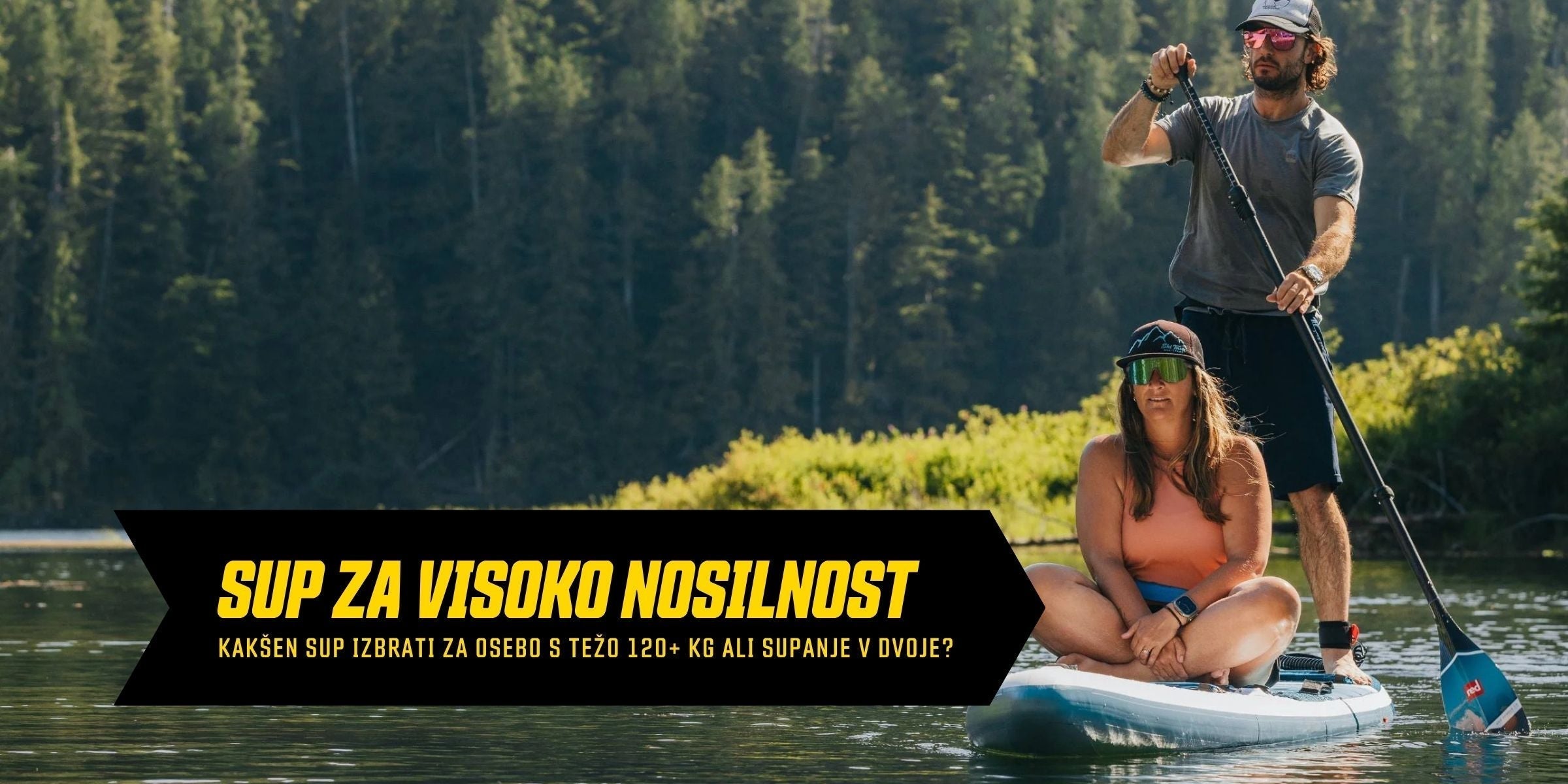
In our practice, a simple rule applies: the recommended load capacity of a paddle board should be at least twice the weight of the heaviest user who will paddle on it. If you weigh 85 kg (187 lbs), look for boards with a load capacity of 170 kg (375 lbs) or more. If you'll be paddling with a child (e.g. 85 + 25 kg / 187 + 55 lbs), aim for a load capacity of at least 220 kg (485 lbs).
This rule comes from the reality of construction tolerances — manufacturers using lower-quality technology often declare high numbers that don't hold up in real conditions.
Watch Out for Big Box Stores
This difference becomes very obvious with cheaper single-layer SUPs from large retail chains. Decathlon paddle boards, for example, mostly declare a 130 kg (287 lbs) load capacity, but in practice (with the manufacturer's own confirmation), they recommend usage up to ~80 kg (176 lbs). For a heavier person, such a board will work for occasional gentle paddling in a sheltered bay, but it won't be stable enough for confident sea paddling or covering longer distances.
That doesn't mean these boards are bad — they're perfectly adequate for occasional lake paddling. But it does mean that if you plan regular outings, sea paddling, or paddling in waves, a 130 kg load capacity isn't enough for a 90 kg paddler. To get sufficient stability, you'd be better off choosing a SUP with a load capacity of at least 180 kg (397 lbs).
"On tours along the Slovenian Adriatic — around Portorož or Castle Devin near Trieste — I often see paddlers experience real disappointment the first time they hit slightly choppy water. At home on the lake, everything was fine; on the sea, the board starts flexing and people lose confidence. So our principle is always: load capacity should be a buffer, not a hard limit."
— Iris, Bananaway instructor
Recommended Paddle Board Dimensions by Weight (Complete Chart)
The chart below comes from 17 years of testing different boards with different paddlers. The logic is this: first determine the right width based on your weight and experience, then the thickness based on the board length that suits your purpose (all-around or touring).
| Weight | Width (beginner) |
Width (experienced) |
Thickness | Length all-around |
Length touring |
Volume | Min. capacity |
|---|---|---|---|---|---|---|---|
| up to 60 kg (132 lbs) |
30'' (76 cm) | 28'' (71 cm) | 12 cm | 9'8–10'6 (295–320 cm) | 11'–12'6 (335–381 cm) | 200–240 L | 150 kg / 331 lbs |
| 60–75 kg (132–165 lbs) |
32'' (81 cm) | 30'' (76 cm) | 12 cm | 10'6 (320 cm) | 11'–12'6 (335–381 cm) | 240–270 L | 180 kg / 397 lbs |
| 75–90 kg (165–198 lbs) |
32'' (81 cm) | 30'' (76 cm) | 12 cm | 10'6–11' (320–335 cm) | 11'6–13' (350–390 cm) | 260–300 L | 200 kg / 441 lbs |
| 90–110 kg (198–243 lbs) |
32''–34'' (81–86 cm) | 30''–32'' (76–81 cm) | 12 or 15 cm | 11'–11'6 (335–350 cm) | 12'6–13'2 (381–402 cm) | 290–330 L | 220 kg / 485 lbs |
| 110+ kg (243+ lbs) |
34'' (86 cm) | 32'' (81 cm) | 15 cm | 11'6–12' (350–366 cm) | 12'6–14' (381–427 cm) | 330+ L | 250 kg / 551 lbs |
How to read the chart:
- Beginner means your first or second SUP season, when you're still building balance
- Experienced paddlers can go ~2'' narrower, since they compensate with body stabilisation — a narrower board will be faster and track better
- All-around SUPs are wider, more manoeuvrable, perfect for exploring, playing, yoga, and casual paddling
- Touring SUPs are longer and narrower, suited for distance riding and regular fitness paddling

Important note: The chart applies to quality-built inflatable paddle boards (double-layer fusion or MSL technology). For cheaper single-layer boards, you should size up by one category in each weight class — the centre flexes under load and the construction can't handle the same demands. The full explanation is in our SUP construction guide.
What Length, Width and Thickness Tell You About a Paddle Board
The three dimensions together define the board's character — how fast it glides, how stable it is, how it handles wind and waves. In the SUP world, dimensions are expressed in imperial units: length in feet (e.g. 10'6) and width and thickness in inches (e.g. 32'' or 4.7'').
Length Determines Speed
Longer SUPs have a longer waterline, so they glide better and are faster with the same effort. As length increases, width usually decreases, which means the boards track better — but they're less stable.
- 8'–9' (240–280 cm): surf SUPs — shortest and slowest, but speed isn't the priority for them
- 10'–11' (304–335 cm): all-around SUPs (the most popular category in Europe)
- 11'–13' (335–390 cm): touring SUPs — designed for longer distances
- 12'–14' (365–426 cm): race SUPs — built for speed
One factor often overlooked: nose rocker (the upward curve). If a board's nose sits 20 cm above water, it's effectively as fast as a 20 cm shorter flat board — meaning length alone doesn't guarantee speed. The key is the combination of a flat profile with enough rigidity that the board doesn't flex.

A paddle board with excessive rocker — slower and less stable than it could be.
Width Determines Stability
A wider SUP is more stable, but also slower (you paddle from further off-centre, so the board zigzags more). A narrower SUP tracks better and is faster, but less stable.
- 27'' (68 cm) and below: race SUPs — very fast, suitable for experienced paddlers only
- 28''–30'' (71–76 cm): touring SUPs — less stable
- 32'' (81 cm): the optimal width for an all-around SUP (the standard for most users)
- 34'' (86 cm) and above: maximum stability, but noticeably slower and less responsive
One often-missed detail: tail width matters as much as middle width. A SUP that's 32'' across the middle but has a heavily tapered tail will feel significantly less stable than a board of the same width with a rounder tail. When choosing a board, check that the tail isn't too narrow.
Thickness Determines Volume
Thickness has the biggest effect on volume — even a 1 cm change significantly alters how much volume the board has. Inflatable SUPs come in three standard thicknesses:
- 10 cm (3.9''): optimal for boards up to 10' in length
- 12 cm (4.7''): optimal for boards 10'–12'
- 15 cm (5.9''): optimal for boards over 12'
These rules apply to quality materials with double-layer or MSL construction. With cheaper single-layer SUPs, manufacturers often size up the thickness — most commonly we see 15 cm thick all-around boards in the 10'–11' range. This is a compromise that compensates for inferior materials. The result: the board is more rigid, but also more exposed to side winds and less stable in choppy conditions, since it sits too high above the water.
Myth: "Thicker board = more stable board."
Reality: What determines stability is rigidity (stiffness), not thickness itself. A board inflated to 20 PSI is up to 56% more rigid than the same board at 10 PSI — and that affects stability far more than 3 extra cm of thickness.
What Volume Do I Need for My Weight?
Board volume is the displacement the SUP creates in water — measured in litres, it determines how much weight the board can comfortably "carry" above the surface. Optimal volume means the board sits properly in the water: not riding too high above it, not submerging.
Benefits of Optimal Volume
- Energy-efficient paddling (less drag)
- Predictable behaviour in wind
- Stability in waves (the board "settles" into the surface rather than floating on top)
- Less fatigue after 2–3 hours of riding
When Volume Is Too High
A SUP with high volume (e.g. 300+ L) makes sense for heavier paddlers (110 kg+ / 243+ lbs) or for tandem riding. For lighter paddlers (under 90 kg / 198 lbs), the opposite effect kicks in:
- The board sits too high above water, becoming less stable in waves
- Side winds catch you and push you off course
- The board is harder to manoeuvre and slower to turn
- Inflation takes considerably longer
When Volume Is Too Low
With insufficient volume for your weight, the board sinks below the surface, the centre submerges, and you're effectively "ploughing" water. Every stroke takes more force, water washes over the rails, and after a few hours of paddling you're noticeably more tired.
"On longer tours where we cover 10 or 15 km in a day, volume becomes decisive. When paddlers with the wrong board reach the halfway point, the difference is dramatic. With the right volume, you can ride all day and not feel destroyed at the end."
— Amanda, expedition leader on the Krka and Temenica rivers
Paddle Board for Two Persons
If you'll use the SUP in tandem (with a child, partner, or dog), add up the weights and plan for the appropriate volume.
Example: parent 80 kg + child 25 kg = 105 kg (231 lbs) total. For this kind of use, you need a SUP in the 105 kg class — that's 290–330 L of volume with a load capacity of at least 220 kg (485 lbs).
Family use doesn't necessarily mean you'll always paddle in tandem. If you'll mostly paddle solo and a companion will join occasionally, it's better to choose a SUP for your own weight. A quality board will handle an extra rider on short distances without trouble. For regular family use, take a look at our family paddle boards or multi-person SUPs.
Specific Cases — Which SUP for 60, 80, 100 and 110 kg
Below are the four most common variants of the "which SUP for X kg" question. For each weight class, we recommend an all-around and a touring model from our range.
SUP for a 60 kg (132 lbs) Paddler
This category covers lighter adults, teenagers, and many women.
Optimal dimensions: width 30'' (76 cm) for beginner or 28'' for experienced, thickness 12 cm, length 9'8–10'6 (all-around) or 11'–12'6 (touring), volume 200–240 L, minimum capacity 150 kg (331 lbs).
Recommended models from our range:
- All-around: Red Paddle Ride 9'8 — ideal for lighter adults and teenagers, very responsive and manoeuvrable
- Touring: Red Paddle Voyager 12'0 — longer and narrower, for those already eyeing tours and exploration
Lighter paddlers don't need high volume. 15 cm thick boards often feel clunky to them — on a quality 12 cm SUP, they'll have a noticeably better time.

SUP for an 80 kg (176 lbs) Paddler — The Most Common Category
Optimal dimensions: width 32'' (81 cm) for beginner or 30'' for experienced, thickness 12 cm, length 10'6–11' (all-around) or 11'6–13' (touring), volume 260–300 L, minimum capacity 200 kg (441 lbs).
Recommended models from our range:
- All-around: Red Paddle Ride 10'6, Gladiator Origin 10'6, Gladiator Pro InOne 10'8 — the "sweet spot" of the market, the most refined category for end users
- Touring: Red Paddle Voyager 12'6, Gladiator Pro InOne 11'6 — for active paddlers who do regular tours
This is our biggest customer category. Competition is fierce, but the differences between models are mostly in technology — more on this in our SUP price tier comparison.
SUP for a 100 kg (220 lbs) Paddler
Optimal dimensions: width 32''–34'' (81–86 cm) for beginner or 30''–32'' for experienced, thickness 12 or 15 cm (depending on technology), length 11'–11'6 (all-around) or 12'6–13'2 (touring), volume 290–330 L, minimum capacity 220 kg (485 lbs).
Recommended models from our range:
- All-around: Red Paddle Ride 10'8, Gladiator Origin 10'8, Gladiator Pro InOne 10'8 — at quality construction levels, a 12 cm board still performs excellently for a 100 kg paddler
- Touring: Red Paddle Voyager 12'6 or 13'2, Gladiator Pro InOne 11'6 — at 100 kg, a touring SUP "settles" into the water beautifully and delivers an excellent ride
At 100 kg, construction technology becomes critical. A single-layer SUP at this weight will flex excessively — choosing a quality fusion or MSL technology really pays off here.
SUP for 110 kg (243 lbs) and Above (Heavier Paddler)
Optimal dimensions: width 34'' (86 cm) for beginner or 32'' for experienced, thickness 15 cm, length 11'6–12' (all-around) or 12'6–14' (touring), volume 330+ L, minimum capacity 250 kg (551 lbs).
Recommended models from our range:
- All-around: Red Paddle Sport 11'0, Red Paddle Ride 10'8 with MSL technology
- Touring: Red Paddle Voyager 13'2 — longer and narrower, glides excellently, high volume
For heavier paddlers (110+ kg), choices are narrower — we strongly advise against single-layer boards, as the centre starts flexing even at standstill. With quality construction, however, you have a wide selection, since 330+ L volume is available across multiple models.
For heavier paddlers, couples, or family use, take a look at our multi-person SUPs collection — every board in this category is built for high capacity loads.
When Higher Volume Pays Off (and When It Doesn't)
High volume (300+ L) makes sense when:
- you're a heavier paddler (110+ kg / 243+ lbs) and need reliable buoyancy
- you paddle in tandem or with a child (combined weight)
- you tour with gear (tent, dry bag, food)
- you do SUP yoga and need a stable, wide platform
We do NOT recommend high volume if:
- you're a lighter paddler (under 90 kg / 198 lbs) looking for an all-around SUP — bigger volume = more wind exposure
- you mostly paddle solo in calm conditions (lake, river)
- you want a more dynamic, playful ride (short manoeuvres, turning)

An oversized SUP can feel stable on the water, but it's slow and clumsy when turning.
The best approach is to have an optimal SUP for your weight — not too big, not too small. Energy is wasted in a board that's too big, and on a board that's too small you're working against the drag.
How to Choose the Right Dimensions Before Buying
Paddle board dimensions are hard to verify without first-hand experience, so we recommend three reliable paths to the right choice — without the risk:
- Take our SUP Quiz — the fastest way to a personalised recommendation based on your weight, experience and paddling style. The quiz draws from our practical experience on courses and demo days, not from manufacturers' marketing specs.
- Visit a demo day or our store — the best way to find out if a board suits you is to try it before buying. Bananaway organises Red Paddle Co demo days at various locations across Slovenia, where you can test 3–5 models in the same season. The difference between an all-around 10'6 and a touring 12'6 under the same paddler is often dramatic. Alternatively, visit our store at Podmilščakova 46 in Ljubljana, where our instructors can recommend models for you after a personal consultation.
- Consult with our instructors — we offer every customer a free pre-purchase consultation. Sometimes the answers to a single question ("Where will you mostly paddle?" or "Will you paddle alone or with a partner?") are enough to narrow three suitable boards down to the one that's truly right.
Next Steps
Now that you know the right dimensions for your weight, choosing a specific model becomes much easier. Logical next steps:
- How construction technology affects SUP quality — why two boards with the same dimensions can behave very differently
- Inflatable vs. hard SUP — which is right for you — most buyers today choose inflatable, but not always for the right reasons
- SUP price tiers — what you get for your money — understanding what to expect at different price points
- Main guide: How to choose a paddle board — the complete decision tree in one place
Or browse our complete paddle board range directly.
Why Trust Our Recommendations
Bananaway has been developing the SUP scene since 2012 and is the official Red Paddle Co distributor in Slovenia. Across 17 years of operation, we've guided more than 12,000 participants through courses, tours and international trips — giving us a unique view of how different paddle boards behave under different paddlers. We're rated 4.9/5 on Tripadvisor from over 436 reviews and rank second among 44 water experience providers in Ljubljana.
We're based in Slovenia and ship across the EU. Our recommendations come from real on-water practice — not from manufacturers' marketing specs.
Naša priporočila izhajajo iz prakse na vodi.
Updates: April 2026